
Table of Contents
Thorne is a distinctive name that evokes images of natural resilience and strength. Originally an English surname meaning ‘thorn bush,’ it has transitioned into a compelling given name with deep roots in Germanic languages. This name carries a rugged, earthy quality that appeals to parents seeking something both traditional and unique. Discover the rich history and modern appeal of Thorne in this comprehensive guide.
Meaning of Thorne
Thorne derives from the Old English word ‘þorn,’ meaning ‘thorn’ or ‘thorn bush.’ This places it firmly within the Germanic language family, specifically the Anglo-Saxon branch that evolved into modern English. The name originally served as a topographic surname, identifying individuals who lived near a notable thorn bush or in an area characterized by thorny vegetation. Similar formations exist across Germanic languages, such as the German ‘Dorn’ or Scandinavian names incorporating ‘torn.’ Unlike the original article’s claim, Thorne is not a shortened form of names beginning with ‘Thor’ (which refers to the Norse god of thunder)—these are distinct etymologies. The thorn bush symbolism suggests protection, resilience, and natural boundaries, reflecting the plant’s historical use in hedgerows.
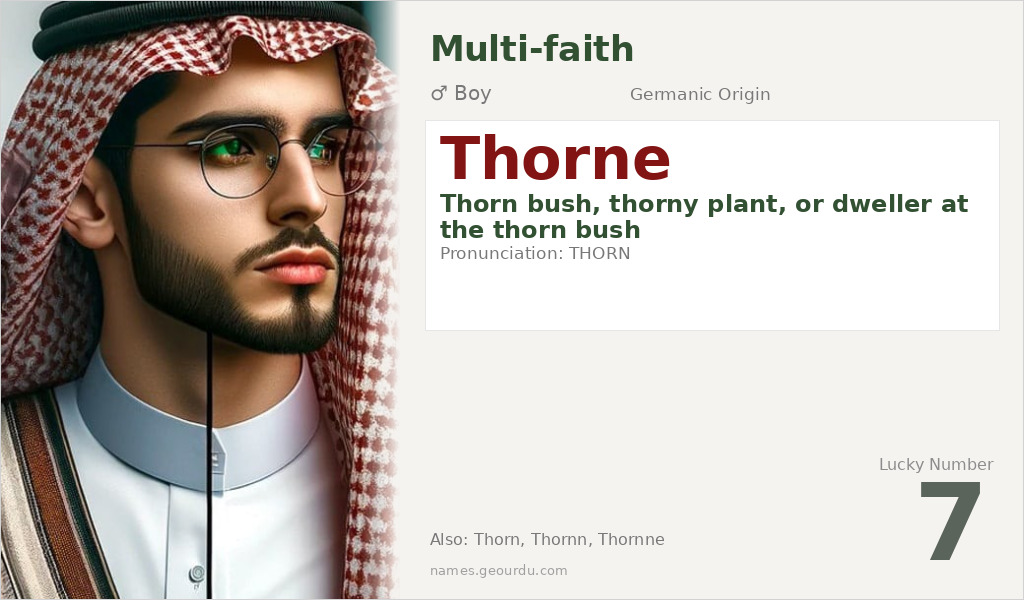
| 📛 Name | Thorne |
| 💎 Meaning | Thorn bush, thorny plant, or dweller at the thorn bush |
| 👤 Gender | Boy |
| 🕌 Religion | Multi-faith |
| 🌍 Origin | Germanic |
| 🗣 Pronunciation | THORN |
| ✍️ Urdu | تھورن |
| ✍️ Arabic | ثورن |
| 🔢 Numerology | 7 |
| ✨ Spellings | Thorn, Thornn, Thornne |
Origin & Cultural Significance
Thorne originated in England as a surname during the Middle Ages, based on topographic features in the landscape. It belongs to a category of English surnames derived from nature, like Brook, Hill, or Wood. The name spread through English-speaking regions via migration and colonization, becoming established in countries like the United States, Canada, and Australia. While it has no inherent religious meaning, it is used by people of various faiths, including Christians, due to its neutral botanical origin. In recent decades, Thorne has gained popularity as a first name, particularly in English-speaking countries, appreciated for its strong, natural connotations and surname-style trend.
Personality Traits
People named Thorne are often associated with traits like resilience, independence, and practicality. The thorn bush symbolism suggests a protective nature and the ability to thrive in challenging conditions. They may be perceived as grounded individuals with a strong sense of self, much like the enduring plant their name references. These characteristics make Thorne a name that conveys quiet strength and natural wisdom.
Similar Names
If you like Thorne, consider: Thor, Thornley, Thornton, Thurston, Thorvald
Famous People Named Thorne
- Thorne Smith — American author known for humorous fantasy novels like 'Topper'
- Thorne Baker — British physicist and inventor who contributed to early television technology
Frequently Asked Questions About Thorne
What does Thorne mean?
Thorne means 'thorn bush' or 'dweller at the thorn bush,' originating from the Old English word 'þorn.'
Is Thorne a boy or girl name?
Thorne is primarily used as a boy's name, though it can be considered unisex in modern contexts. Historically, it appears more frequently for males.
What is the origin of Thorne?
Thorne has Germanic origins, specifically from Old English, where it began as a topographic surname before becoming a given name.





