
Table of Contents
Umdatuddawlah is a distinguished Arabic name with deep historical roots in Islamic civilization. Meaning ‘Pillar of the State,’ this name carries connotations of stability, leadership, and essential support within governance structures. Traditionally used as both a personal name and honorific title, Umdatuddawlah reflects the rich tradition of compound names in Arabic culture that emphasize virtues and societal roles. Today, it remains a meaningful choice for parents seeking a name with historical gravitas and noble significance.
Meaning of Umdatuddawlah
Umdatuddawlah derives from classical Arabic, combining ‘Umdat’ (عُمدَة) meaning ‘pillar, support, or foundation’ with ‘ad-Dawlah’ (الدَّوْلَة) meaning ‘the state, government, or dynasty.’ The complete phrase translates precisely to ‘Pillar of the State,’ indicating someone who is fundamental to the functioning and stability of political authority. Linguistically, ‘Umdat’ comes from the root ‘ع-م-د’ (ayn-mim-dal) relating to pillars, supports, and foundations, while ‘Dawlah’ originates from ‘د-و-ل’ (dal-waw-lam) meaning to rotate, alternate, or govern—referring to the cyclical nature of power and governance. This compound construction follows traditional Arabic naming patterns where elements are combined to create meaningful descriptors, often used historically as titles before becoming personal names.
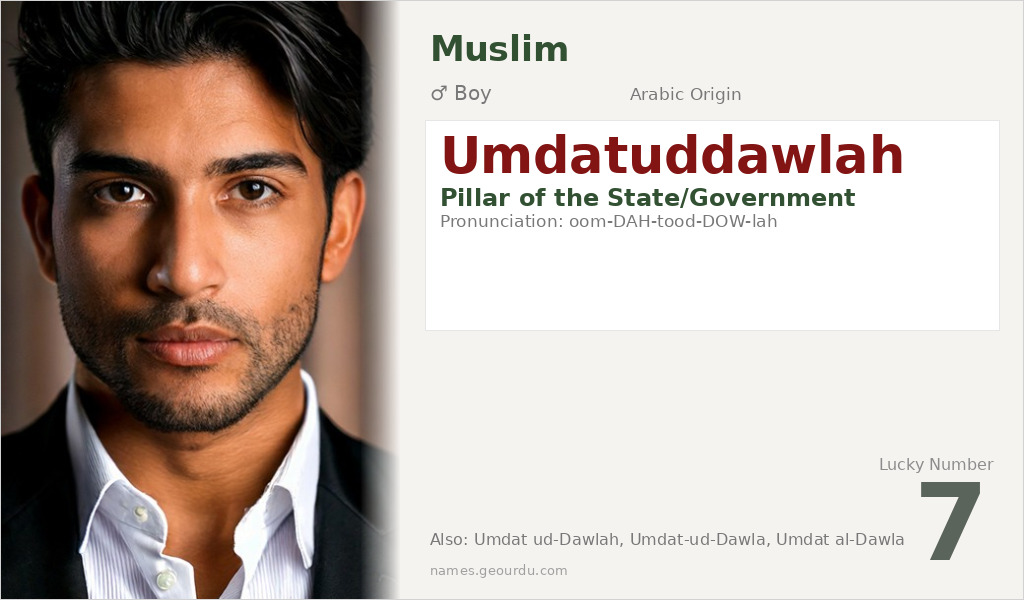
| 📛 Name | Umdatuddawlah |
| 💎 Meaning | Pillar of the State/Government |
| 👤 Gender | Boy |
| 🕌 Religion | Muslim |
| 🌍 Origin | Arabic |
| 🗣 Pronunciation | oom-DAH-tood-DOW-lah |
| ✍️ Urdu | عمدۃ الدولہ |
| ✍️ Arabic | عمدۃ الدولة |
| 🔢 Numerology | 7 |
| ✨ Spellings | Umdat ud-Dawlah, Umdat-ud-Dawla, Umdat al-Dawla, Umdatuddawla |
Origin & Cultural Significance
The name Umdatuddawlah originated in the Islamic world during the medieval period, particularly within Arab and Persianate societies. It was initially used as an honorific title (laqab) for high-ranking officials, viziers, and sometimes rulers who were considered essential supports of the governing system. Historical records show its usage among the Buyid dynasty (934-1062 CE) in Persia and Iraq, where several rulers bore variations of this title. The name reflects the Islamic tradition of using compound names that denote relationship to God (like -uddin names) or to governance and society. While primarily Arabic in origin, the name spread through Persian, Turkish, and Urdu-speaking regions due to historical Islamic empires, though it remains most closely associated with Arabic linguistic and cultural heritage.
Personality Traits
Those named Umdatuddawlah are often associated with qualities of reliability, strength, and leadership. The name’s meaning suggests someone who provides essential support and stability in their family, community, or workplace. They may naturally assume responsible positions and excel in roles requiring organization and dependability. While personality traits vary by individual, the name carries cultural expectations of being a foundational figure who others can depend upon during challenging times.
Similar Names
If you like Umdatuddawlah, consider: Imaduddin, Nizamuddin, Saifuddin, Fakhruddin, Shamsuddin
Famous People Named Umdatuddawlah
- Umdat al-Dawla — Historical title used by several Islamic rulers and officials, notably by Buyid dynasty rulers in 10th-11th century Persia
- Umdat al-Dawla Abu Kalijar — 11th century Buyid ruler of Fars and Iraq
Frequently Asked Questions About Umdatuddawlah
What does Umdatuddawlah mean?
Umdatuddawlah means 'Pillar of the State' or 'Support of the Government' in Arabic. It is a compound name from 'Umdat' (pillar) and 'ad-Dawlah' (the state).
Is Umdatuddawlah a boy or girl name?
Umdatuddawlah is exclusively a boy's name in Arabic and Islamic naming traditions. It has historically been used for males as both a personal name and honorific title.
What is the origin of Umdatuddawlah?
Umdatuddawlah originates from classical Arabic and Islamic culture. It was used as a title in medieval Islamic governance, particularly during the Abbasid and Buyid periods, before becoming established as a personal name.





