
Table of Contents
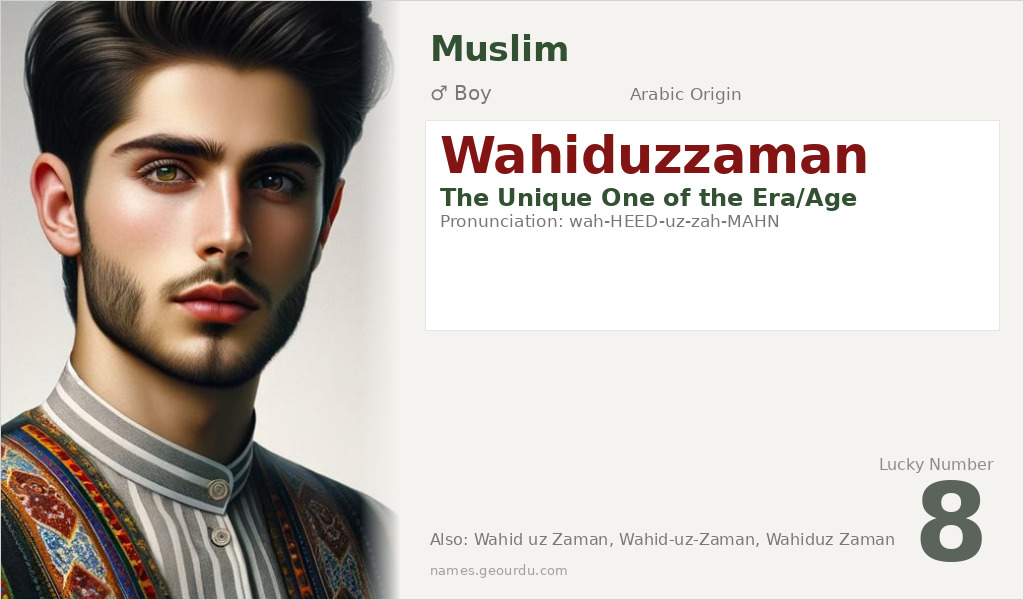
Wahiduzzaman is a profound Arabic name that carries deep theological and cultural significance within Muslim communities worldwide. Meaning ‘The Unique One of the Era’, this name reflects both divine attributes and aspirational human qualities. Historically used in Islamic scholarship and literature, it continues to be chosen by parents seeking a name with spiritual depth and timeless meaning. Let’s explore the rich linguistic heritage and contemporary relevance of this distinctive name.
Meaning of Wahiduzzaman
Wahiduzzaman derives from classical Arabic, combining ‘Wahid’ (واحد) meaning ‘one, unique, singular’ with ‘Zaman’ (زمان) meaning ‘era, age, time’. The complete name translates to ‘Unique of the Era’ or ‘The One of the Age’, emphasizing unparalleled uniqueness across temporal dimensions. In Islamic theology, ‘Al-Wahid’ is one of the 99 Names of Allah, referring to God’s absolute oneness and indivisibility. When combined with ‘Zaman’, the name takes on a temporal dimension, suggesting uniqueness that transcends any particular historical period. This construction follows common Arabic naming patterns where divine attributes are referenced in compound names, though Wahiduzzaman is less common than simpler forms like Abdul-Wahid.
| 📛 Name | Wahiduzzaman |
| 💎 Meaning | The Unique One of the Era/Age |
| 👤 Gender | Boy |
| 🕌 Religion | Muslim |
| 🌍 Origin | Arabic |
| 🗣 Pronunciation | wah-HEED-uz-zah-MAHN |
| ✍️ Urdu | واحد الزمان |
| ✍️ Arabic | واحد الزمان |
| 🔢 Numerology | 8 |
| ✨ Spellings | Wahid uz Zaman, Wahid-uz-Zaman, Wahiduz Zaman, Vahiduzzaman |
Origin & Cultural Significance
Wahiduzzaman originates from Arabic linguistic and Islamic cultural traditions, with documented usage across the Muslim world from South Asia to the Middle East. The name gained particular prominence in regions influenced by Persianate culture, where compound Arabic names were often adopted by scholarly and aristocratic families. In South Asia, especially Bangladesh, India, and Pakistan, the name became associated with educated Muslim families during the Mughal and colonial periods. While primarily an Arabic name, it has been adopted into various languages including Urdu, Persian, and Bengali with minimal phonetic adaptation. The name reflects the Islamic emphasis on tawhid (divine unity) while incorporating temporal consciousness, making it philosophically rich within Islamic naming traditions.
Personality Traits
The name Wahiduzzaman suggests someone with strong individual character and historical awareness. Those bearing this name are often perceived as principled individuals who value uniqueness and authenticity in their personal and professional lives. The name’s meaning implies a person who stands out in their generation, potentially exhibiting leadership qualities, independent thinking, and a sense of purpose that transcends contemporary trends. While personality traits cannot be determined by names alone, the linguistic meaning often influences cultural perceptions and expectations.
Similar Names
If you like Wahiduzzaman, consider: Abdul-Wahid, Wahid, Zaman, Ahad, Samad, Quddus
Famous People Named Wahiduzzaman
- Wahiduzzaman — Bangladeshi politician and former Minister of Agriculture
- Wahiduzzaman — Indian cricketer who played for Bengal in domestic cricket
Frequently Asked Questions About Wahiduzzaman
What does Wahiduzzaman mean?
Wahiduzzaman means 'The Unique One of the Era' or 'Unique of the Age' in Arabic. It combines 'Wahid' (unique/one) and 'Zaman' (era/time) to create a name with theological and philosophical depth.
Is Wahiduzzaman a boy or girl name?
Wahiduzzaman is exclusively a boy's name in all cultural contexts where it is used. Arabic compound names with this structure are traditionally masculine, and there are no recorded feminine variants in any Muslim naming traditions.
What is the origin of Wahiduzzaman?
Wahiduzzaman originates from classical Arabic language and Islamic culture. It is a compound name that references divine attributes ('Al-Wahid' being one of Allah's 99 Names) while incorporating the temporal element 'Zaman' (era/time).





