Table of Contents
Yakshini is a captivating name steeped in ancient Indian mythology and spirituality. Derived from Sanskrit, it refers to enchanting female nature spirits or demigoddesses celebrated in Hindu, Buddhist, and Jain traditions. This name evokes imagery of beauty, protection, and mystical connection to the natural world. Choosing Yakshini honors a legacy of celestial beings who guard treasures and sacred spaces.
Meaning of Yakshini
Yakshini comes from the Sanskrit word ‘यक्षिणी’ (yakṣiṇī), the feminine form of ‘यक्ष’ (yakṣa), meaning a nature spirit, demigod, or supernatural being. The term is rooted in ancient Indian religions, where Yakshinis are depicted as benevolent female entities associated with forests, mountains, fertility, and protection. In texts like the Mahabharata and Puranas, they serve as attendants to gods like Kubera and Durga, but also have independent roles as guardians of natural and divine treasures. Linguistically, the suffix ‘-ini’ denotes femininity, making Yakshini specifically a female counterpart to the male Yaksha.
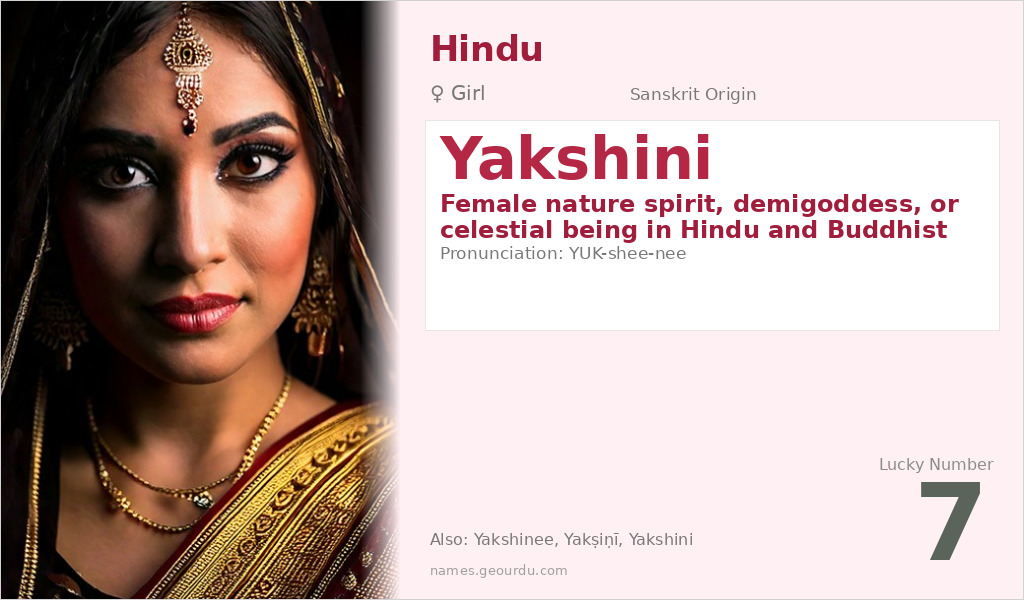
| 📛 Name | Yakshini |
| 💎 Meaning | Female nature spirit, demigoddess, or celestial being in Hindu and Buddhist mythology; specifically a female counterpart to Yaksha |
| 👤 Gender | Girl |
| 🕌 Religion | Hindu |
| 🌍 Origin | Sanskrit |
| 🗣 Pronunciation | YUK-shee-nee |
| ✍️ Urdu | یکشنی |
| ✍️ Arabic | يَكْشِينِي |
| 🔢 Numerology | 7 |
| ✨ Spellings | Yakshinee, Yakṣiṇī, Yakshini, Yakshiny |
Origin & Cultural Significance
The name Yakshini originates from Sanskrit, the classical language of India, and is deeply embedded in Hindu, Buddhist, and Jain mythology. Historically, Yakshinis appear in ancient Indian art, literature, and temple sculptures dating back to the Mauryan and Gupta periods. Culturally, they are revered as celestial beings who embody natural forces, often depicted with voluptuous forms and symbolic attributes like fruit or jewels. While primarily associated with Hinduism, Yakshinis also feature in Buddhist tales as protectors of the Dharma and in Jain narratives as supernatural attendants.
Personality Traits
Named after mystical guardians of nature, Yakshini suggests a personality that is intuitive, nurturing, and spiritually attuned. Those with this name may be seen as artistic, empathetic, and protective, mirroring the benevolent and watchful qualities of the mythological Yakshinis. They often possess a calming influence and a deep appreciation for beauty and tradition.
Similar Names
If you like Yakshini, consider: Yaksha, Apsara, Devi, Gandharvi, Kinnari
Famous People Named Yakshini
- Yakshini (mythological figure) — a prominent Yakshini in Hindu and Buddhist texts, often depicted in ancient Indian sculpture and temple art
- Yakshini (character) — appears in Indian folklore, classical literature like the Mahabharata, and modern media as a supernatural being
Frequently Asked Questions About Yakshini
What does Yakshini mean?
Yakshini means 'female nature spirit,' 'demigoddess,' or 'celestial being' in Sanskrit, referring to benevolent supernatural females in Hindu, Buddhist, and Jain mythology.
Is Yakshini a boy or girl name?
Yakshini is exclusively a girl name, as it is the feminine form of the Sanskrit word Yaksha, with the '-ini' suffix indicating female gender.
What is the origin of Yakshini?
Yakshini originates from Sanskrit, the ancient language of India, and is deeply rooted in Hindu mythology, with connections to Buddhist and Jain traditions as well.