
Table of Contents
York is a distinguished name with deep historical roots tracing back to one of England’s most famous cities. Originally a geographical surname, it has evolved into a unique given name carrying centuries of heritage. The name embodies English history from Roman times through medieval periods to modern usage. Parents choosing York often appreciate its strong, traditional sound and connection to historical significance.
Meaning of York
The name York derives from the English city of York, which itself has a complex linguistic history. Its earliest form was Latin ‘Eboracum’ during Roman Britain, meaning ‘yew-tree estate’. This evolved into Old English ‘Eoforwic’ (‘boar settlement’) during Anglo-Saxon times, then transformed to ‘Jórvík’ under Norse Viking influence. The modern ‘York’ combines elements from these linguistic layers, with the predominant accepted meaning being ‘yew-tree estate’ or ‘settlement of yew trees’. The yew tree held significant symbolic meaning in ancient British cultures, representing longevity and resilience.
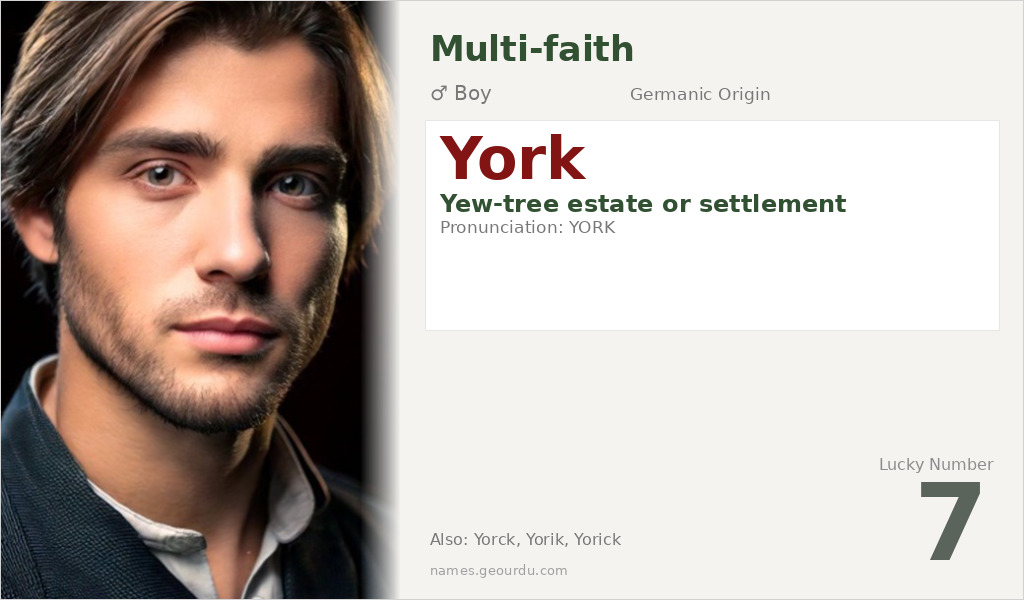
| 📛 Name | York |
| 💎 Meaning | Yew-tree estate or settlement |
| 👤 Gender | Boy |
| 🕌 Religion | Multi-faith |
| 🌍 Origin | Germanic |
| 🗣 Pronunciation | YORK |
| ✍️ Urdu | یارک |
| ✍️ Arabic | يورك |
| 🔢 Numerology | 7 |
| ✨ Spellings | Yorck, Yorik, Yorick |
Origin & Cultural Significance
York originates as a geographical surname from the historic city of York in North Yorkshire, England. The city served as a Roman capital (Eboracum), Viking settlement (Jórvík), and medieval ecclesiastical center. As a given name, York gained popularity in English-speaking countries, particularly among families with connections to Yorkshire or English heritage. It represents the English tradition of using place names as personal names, similar to London, Kent, or Chester. The name carries no specific religious association despite the city’s Christian history, making it suitable for multi-faith contexts.
Personality Traits
Those named York often project strength, tradition, and reliability. The name’s historical weight lends a sense of permanence and connection to heritage. York-named individuals may naturally exhibit leadership qualities and respect for established systems, reflecting the name’s origins in a historically significant settlement. Their personality often balances traditional values with practical adaptability.
Similar Names
If you like York, consider: Yorke, Yorick, Yorker, Yorkshire, New York
Famous People Named York
- York (character) — Shakespeare's 'Richard III' (Duke of York)
- York (surname) — numerous historical figures including English nobility and American settlers
Frequently Asked Questions About York
What does York mean?
York means 'yew-tree estate' or 'settlement of yew trees', originating from the English city of York through Old English and Latin roots.
Is York a boy or girl name?
York is predominantly used as a boy's name, though as a place name it could theoretically be unisex. Historical and contemporary usage overwhelmingly favors male bearers.
What is the origin of York?
York originates from England as a geographical surname derived from the city of York, with linguistic roots in Latin 'Eboracum' and Old English 'Eoforwic', evolving through Norse influence.





