
Table of Contents
Nagarjuna is a profound and historically rich name with deep roots in Buddhist philosophy and Sanskrit tradition. Primarily used for boys, it carries a meaning that symbolizes victory over serpentine forces, representing the triumph of wisdom over ignorance. This name is most famously associated with the influential 2nd-3rd century Buddhist thinker Nagarjuna, whose teachings shaped Mahayana Buddhism. Today, it remains a meaningful choice for parents seeking a name with spiritual depth and cultural heritage.
Meaning of Nagarjuna
The name Nagarjuna originates from Sanskrit, combining ‘nāga’ (नाग), meaning ‘serpent’ or ‘dragon’, and ‘arjuna’ (अर्जुन), meaning ‘white’, ‘clear’, or ‘victorious’. Thus, Nagarjuna literally translates to ‘one who is victorious over serpents’ or ‘conqueror of dragons’. In Buddhist context, serpents often symbolize ignorance, obstacles, or negative forces, so the name implies mastery over these challenges. The ‘arjuna’ component also connects to the Hindu epic Mahabharata, where Arjuna is a heroic archer, adding layers of valor and purity. This compound structure is typical in Sanskrit names, where elements combine to create specific, meaningful identities. Etymologically, it’s well-documented in ancient Indian texts and Buddhist scriptures, making its meaning clear and historically verified.
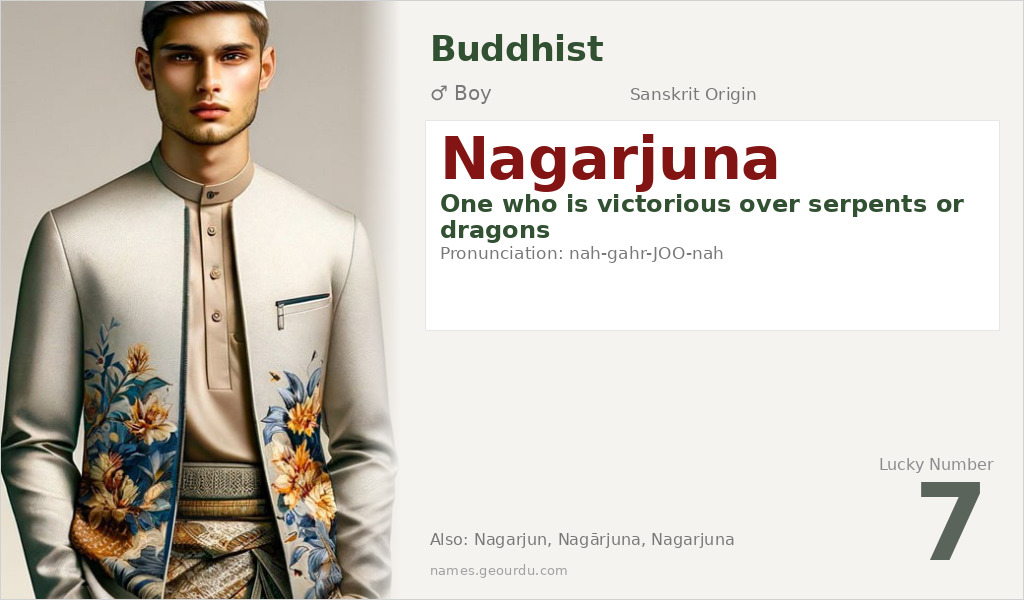
| 📛 Name | Nagarjuna |
| 💎 Meaning | One who is victorious over serpents or dragons |
| 👤 Gender | Boy |
| 🕌 Religion | Buddhist |
| 🌍 Origin | Sanskrit |
| 🗣 Pronunciation | nah-gahr-JOO-nah |
| ✍️ Urdu | ناگارجُن |
| ✍️ Arabic | ناغارجونا |
| 🔢 Numerology | 7 |
| ✨ Spellings | Nagarjun, Nagārjuna, Nagarjuna |
Origin & Cultural Significance
Nagarjuna has its origins in ancient India, specifically from Sanskrit language and Buddhist tradition. It gained prominence through Nagarjuna, the renowned Buddhist philosopher of the 2nd-3rd century CE, who founded the Madhyamaka school and is considered a key figure in Mahayana Buddhism. While the name appears in some Hindu contexts due to Sanskrit’s pan-Indian use, its primary religious and cultural association is Buddhist, reflecting themes of enlightenment and overcoming adversity. Historically, the name spread across Asia with Buddhism, influencing cultures in Tibet, China, and Japan, though it remains most common in Indian and Buddhist communities. In modern times, it’s used in India and among Buddhist families worldwide, often honoring the philosophical legacy of its most famous bearer.
Personality Traits
Those named Nagarjuna are often thought to embody wisdom, introspection, and spiritual strength, inspired by the name’s philosophical heritage. They may display a calm, analytical nature, with an ability to navigate complex situations—much like conquering symbolic serpents. This name suggests a person who values truth, seeks deeper understanding, and approaches life with resilience and clarity. While personality traits can vary individually, the name’s etymological roots in victory and purity often inspire perceptions of thoughtful and determined character.
Similar Names
If you like Nagarjuna, consider: Arjuna, Nagesh, Nagendra, Vasuki, Takshaka
Famous People Named Nagarjuna
- Nagarjuna — 2nd-3rd century Indian Buddhist philosopher, founder of Madhyamaka school and considered one of the most important Buddhist thinkers
- Akkineni Nagarjuna — Indian film actor and producer primarily working in Telugu cinema, named after the philosopher
Frequently Asked Questions About Nagarjuna
What does Nagarjuna mean?
Nagarjuna means 'one who is victorious over serpents or dragons' in Sanskrit, derived from 'nāga' (serpent) and 'arjuna' (victorious/white).
Is Nagarjuna a boy or girl name?
Nagarjuna is traditionally a boy's name, rooted in masculine Sanskrit grammar and historically associated with male figures like the Buddhist philosopher Nagarjuna.
What is the origin of Nagarjuna?
Nagarjuna originates from Sanskrit language and Buddhist tradition in ancient India, famously borne by the 2nd-3rd century Buddhist philosopher Nagarjuna.





