
Table of Contents
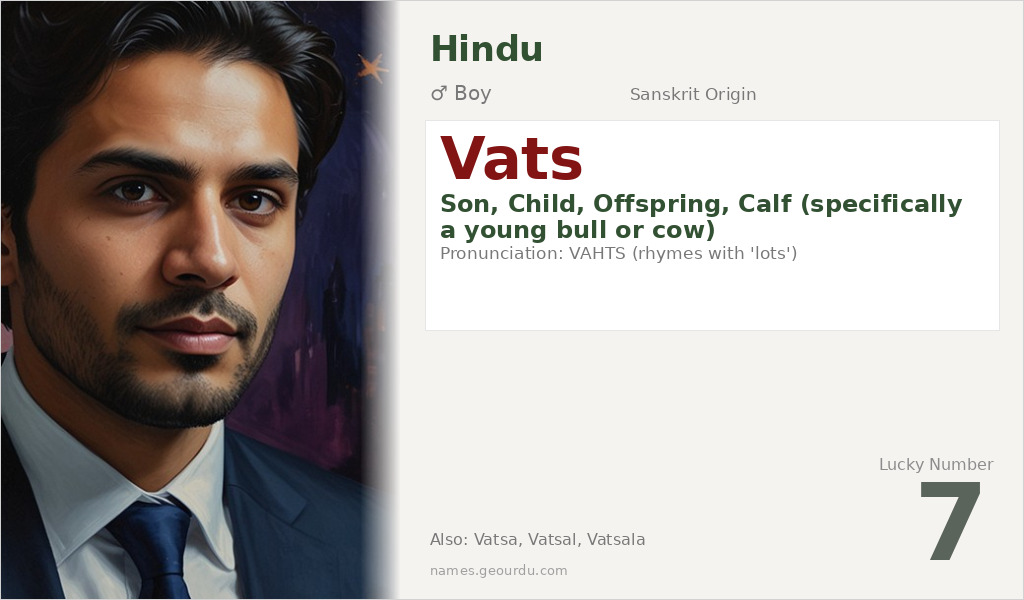
Vats is a classic Hindu boy name with deep roots in ancient Sanskrit literature and Hindu tradition. Meaning ‘son’ or ‘calf,’ it carries connotations of affection, progeny, and familial bonds. This name is not only phonetically simple but rich in cultural heritage, often chosen for its traditional and endearing significance. Explore the origins, meanings, and personality traits associated with the name Vats.
Meaning of Vats
The name Vats originates from the Sanskrit word ‘वत्स’ (vatsa), which literally translates to ‘calf,’ referring specifically to the young of a cow or bull. In a broader sense, it is used metaphorically to mean ‘child,’ ‘son,’ or ‘offspring,’ symbolizing youth, innocence, and beloved progeny. This term is prevalent in Vedic texts, such as the Rigveda, and later works like the Mahabharata, where it denotes affectionate address towards children. Additionally, in Hindu mythology, Vats is linked to sage Kanva, making it mean ‘a descendant of Kanva’ in certain contexts, though its primary meaning remains rooted in its Sanskrit etymology as ‘young one’ or ‘son.’
| 📛 Name | Vats |
| 💎 Meaning | Son, Child, Offspring, Calf (specifically a young bull or cow) |
| 👤 Gender | Boy |
| 🕌 Religion | Hindu |
| 🌍 Origin | Sanskrit |
| 🗣 Pronunciation | VAHTS (rhymes with 'lots') |
| ✍️ Urdu | وتس |
| ✍️ Arabic | فاتس |
| 🔢 Numerology | 7 |
| ✨ Spellings | Vatsa, Vatsal, Vatsala |
Origin & Cultural Significance
Vats has its origins in Sanskrit, one of the oldest languages of the Indian subcontinent, with usage dating back to Vedic times around 1500 BCE. It is predominantly used within Hindu communities, reflecting the cultural and religious significance of progeny and family in Hinduism. The name is often found in Indian literature and mythology, such as in the story of Shakuntala, where Kanva refers to her as ‘Vatsa,’ highlighting its endearing use. While primarily a Hindu name, its simplicity and meaning have made it recognizable in various Indian languages and dialects, though it remains most common in Sanskrit-derived contexts.
Personality Traits
People named Vats are often perceived as caring, loyal, and grounded, with a natural inclination towards protecting and nurturing those around them. Their personality may reflect the gentle and steady qualities associated with a calf, leading to a calm and reliable demeanor. They tend to value family and tradition, making them respectful and affectionate individuals in social and personal spheres.
Similar Names
If you like Vats, consider: Vatsal, Vatsala, Vatsin, Putra, Suta, Kumar, Balak, Shishu
Famous People Named Vats
- Vats — Indian actor known for roles in Tamil and Telugu films
- Vatsal Sheth — Indian television and film actor
Frequently Asked Questions About Vats
What does Vats mean?
Vats means 'son,' 'child,' or 'calf' in Sanskrit, with specific connotations of offspring and affection, and can also refer to 'a descendant of Kanva' in Hindu mythology.
Is Vats a boy or girl name?
Vats is traditionally a boy name in Hindu culture, derived from masculine Sanskrit roots meaning 'son' or 'calf,' though related forms like Vatsala are used for girls.
What is the origin of Vats?
Vats originates from Sanskrit, an ancient Indo-Aryan language of India, and is deeply embedded in Hindu religious texts and traditions.





