
Table of Contents
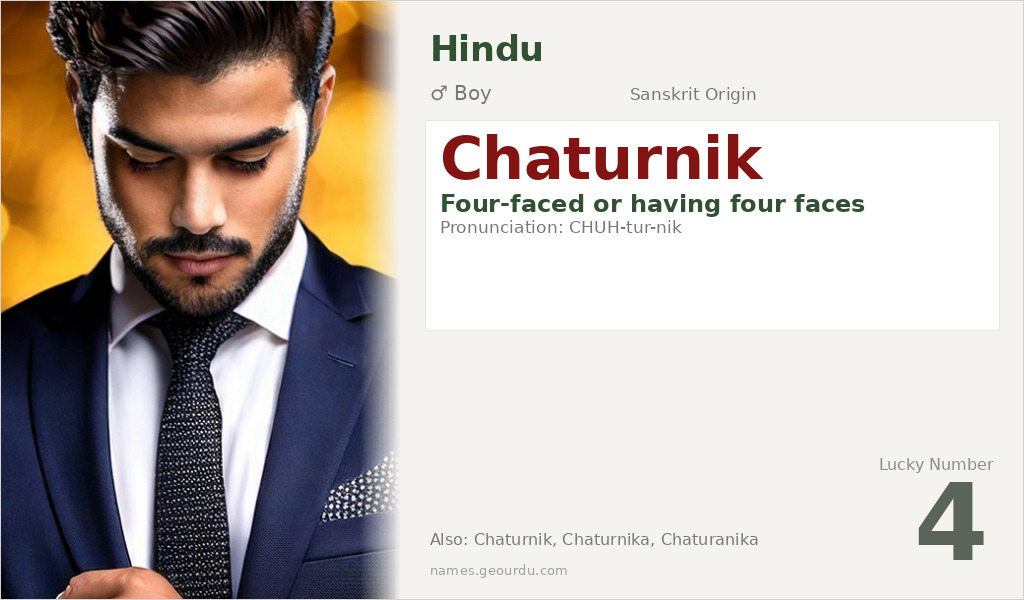
Chaturnik is a distinctive Hindu boy name with deep roots in Sanskrit mythology and philosophy. Meaning ‘four-faced’ or ‘one with four faces’, this name carries profound symbolic significance in Hindu tradition. While uncommon in modern usage, it represents an important cultural and religious concept that continues to inspire naming choices. This comprehensive guide explores the etymology, cultural context, and characteristics associated with this meaningful name.
Meaning of Chaturnik
Chaturnik derives from the Sanskrit compound ‘chatur-anika’, where ‘chatur’ (चतुर्) means ‘four’ and ‘anika’ (अनिक) means ‘face’, ‘appearance’, or ‘countenance’. The complete meaning is ‘four-faced’ or ‘having four faces’. This directly references the Hindu creator god Brahma, who is traditionally depicted with four faces representing his omniscience and connection to the four Vedas (sacred texts), four directions, and four stages of life. The name appears in classical Sanskrit literature and regional naming traditions, particularly in northern India where Sanskrit-derived names remain culturally significant. Unlike the original article’s suggestion, this attribute is specifically associated with Brahma rather than Varuna, who is typically depicted with one face in Hindu iconography.
| 📛 Name | Chaturnik |
| 💎 Meaning | Four-faced or having four faces |
| 👤 Gender | Boy |
| 🕌 Religion | Hindu |
| 🌍 Origin | Sanskrit |
| 🗣 Pronunciation | CHUH-tur-nik |
| ✍️ Urdu | چترنک |
| ✍️ Arabic | تشاتورنيك |
| 🔢 Numerology | 4 |
| ✨ Spellings | Chaturnik, Chaturnika, Chaturanika, Chatur-anik |
Origin & Cultural Significance
Chaturnik originates from classical Sanskrit, the ancient liturgical language of Hinduism that has influenced naming traditions across South Asia for millennia. The name emerges from Hindu philosophical and mythological contexts where the concept of ‘four-faced’ (chaturmukha) represents comprehensive knowledge, creation, and divine wisdom. While not among the most common contemporary names, it appears in historical texts and regional naming practices, particularly in Brahmin communities and areas with strong Sanskrit scholarly traditions. The name reflects the enduring influence of Sanskrit compound formations in Hindu onomastics, where meaningful elements combine to create names with specific symbolic and religious significance.
Personality Traits
Those named Chaturnik are often associated with qualities of wisdom, creativity, and comprehensive understanding, mirroring the symbolic attributes of the four-faced Brahma. They may demonstrate the ability to perceive situations from multiple perspectives and approach challenges with balanced judgment. The name suggests intellectual depth, spiritual awareness, and a connection to traditional knowledge systems, potentially influencing personality development toward philosophical contemplation and holistic thinking.
Similar Names
If you like Chaturnik, consider: Chatur, Chaturbhuj, Chaturdasa, Chaturmukha, Chaturanga
Famous People Named Chaturnik
- No widely known contemporary figures with this name found in verified sources
- Historical references appear in Sanskrit texts describing Brahma as 'Chaturmukha' (four-faced)
Frequently Asked Questions About Chaturnik
What does Chaturnik mean?
Chaturnik means 'four-faced' or 'having four faces' in Sanskrit, directly referencing the Hindu creator god Brahma who is depicted with four faces representing omniscience and the four Vedas.
Is Chaturnik a boy or girl name?
Chaturnik is exclusively a boy name in Hindu naming tradition, derived from masculine Sanskrit grammatical forms and associated with the male deity Brahma.
What is the origin of Chaturnik?
Chaturnik originates from Sanskrit, the ancient liturgical language of Hinduism, combining 'chatur' (four) and 'anika' (face) to create a compound name with specific mythological and philosophical significance.





