
Table of Contents
Phil is a classic, friendly name with ancient Greek roots that has remained popular across centuries and cultures. As a shortened form of Philip, it carries the noble meaning ‘lover of horses’ while also conveying warmth and approachability. This name has been borne by kings, athletes, artists, and everyday people who appreciate its straightforward charm. Whether you’re considering it for a baby or curious about its history, Phil offers a rich linguistic and cultural story.
Meaning of Phil
The name Phil originates from the Greek name Philippos (Φίλιππος), which combines ‘philos’ meaning ‘friend, lover’ and ‘hippos’ meaning ‘horse’. This creates the literal translation ‘lover of horses’ or ‘friend of horses’. In ancient Greece, horses were symbols of wealth, status, and military power, making this name particularly significant among nobility and warriors. The ‘philos’ component gives the name its secondary meaning of ‘friend’ or ‘beloved’, emphasizing affectionate relationships. While Phil is often used as a standalone name today, it historically functioned as a diminutive or nickname for Philip. The name spread throughout Europe via Latin (Philippus) and became popular in Christian contexts due to Saint Philip the Apostle.
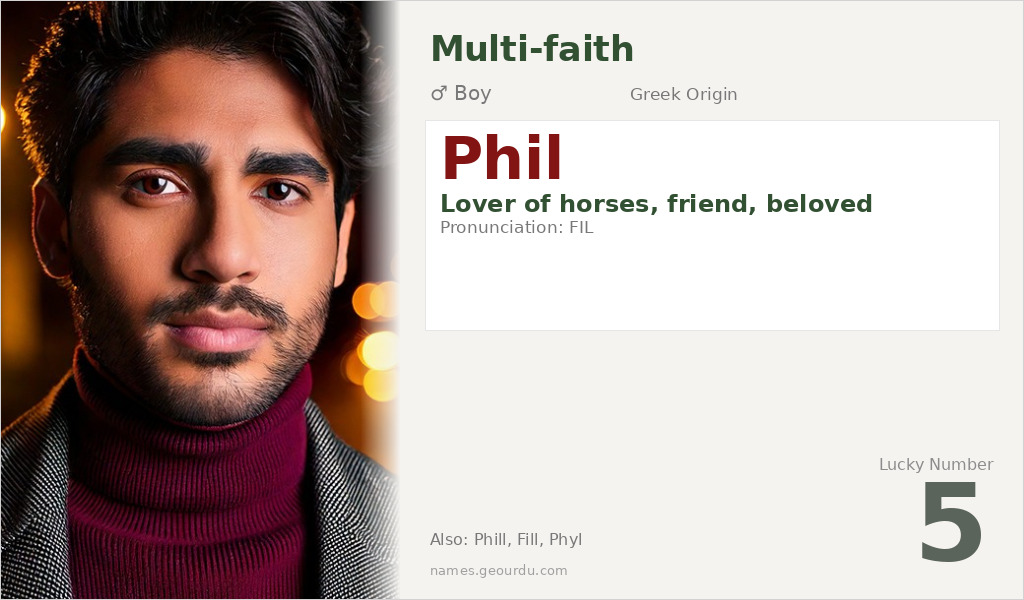
| 📛 Name | Phil |
| 💎 Meaning | Lover of horses, friend, beloved |
| 👤 Gender | Boy |
| 🕌 Religion | Multi-faith |
| 🌍 Origin | Greek |
| 🗣 Pronunciation | FIL |
| ✍️ Urdu | فل |
| ✍️ Arabic | فيل |
| 🔢 Numerology | 5 |
| ✨ Spellings | Phill, Fill, Phyl |
Origin & Cultural Significance
Phil has its origins in ancient Greece, where the full name Philippos was common among Macedonian royalty, most notably Philip II, father of Alexander the Great. The name entered Christian tradition through Saint Philip the Apostle, one of the twelve disciples of Jesus. During the Middle Ages, the name spread throughout Europe in various forms: Philippe in French, Felipe in Spanish, Filippo in Italian, and Philip in English. The shortened form Phil emerged as a casual variant in English-speaking countries, particularly gaining popularity in the 20th century. Today, it’s used internationally, though primarily in Western cultures, and isn’t tied to any specific religion despite its biblical associations.
Personality Traits
People named Phil are often perceived as approachable, reliable, and good-natured. Their name’s meaning of ‘friend’ seems to manifest in their sociable personalities and ability to connect with others. Many Phils demonstrate versatility and adaptability, thriving in various social and professional settings. While individual personalities vary, the name carries connotations of warmth and trustworthiness that often align with those who bear it.
Similar Names
If you like Phil, consider: Philip, Phillip, Felipe, Philipp, Filip, Phelan, Philemon, Philander, Philbert, Phineas
Famous People Named Phil
- Phil Collins — British musician, singer, and drummer known for his work with Genesis and solo career
- Phil Mickelson — American professional golfer with multiple major championship wins
- Phil Jackson — American basketball coach who won 11 NBA championships
- Phil Donahue — American media personality and television host
- Phil Spector — American record producer known for his 'Wall of Sound' technique
Frequently Asked Questions About Phil
What does Phil mean?
Phil means 'lover of horses' or 'friend'. It comes from the Greek name Philippos, combining 'philos' (friend/lover) and 'hippos' (horse).
Is Phil a boy or girl name?
Phil is traditionally a masculine name, though very rarely used for girls. It's the shortened form of Philip, which is exclusively masculine across cultures.
What is the origin of Phil?
Phil originates from ancient Greek as a shortened form of Philippos. It entered Western naming traditions through Latin and Christian contexts, particularly via Saint Philip the Apostle.





