Table of Contents
Philipe is a timeless masculine name with roots stretching back to ancient Greece. Meaning ‘lover of horses’ or ‘friend of horses,’ this name carries centuries of historical significance and royal associations. From Macedonian kings to modern European royalty, Philipe and its variants have maintained popularity across cultures and languages. Discover the rich heritage and enduring appeal of this classic name.
Meaning of Philipe
The name Philipe derives from the Greek Φίλιππος (Philippos), which combines φίλος (philos) meaning ‘friend’ or ‘lover’ and ἵππος (hippos) meaning ‘horse.’ This creates the literal meaning ‘lover of horses’ or ‘friend of horses.’ In ancient Greek society, horses were symbols of wealth, status, and military power, making this name particularly significant among nobility and warriors. The name appears in classical Greek literature and was famously borne by Philip II of Macedon in the 4th century BCE. Through Latin and subsequent European languages, the name evolved into various forms including Philip, Phillip, Felipe, and Philipe.
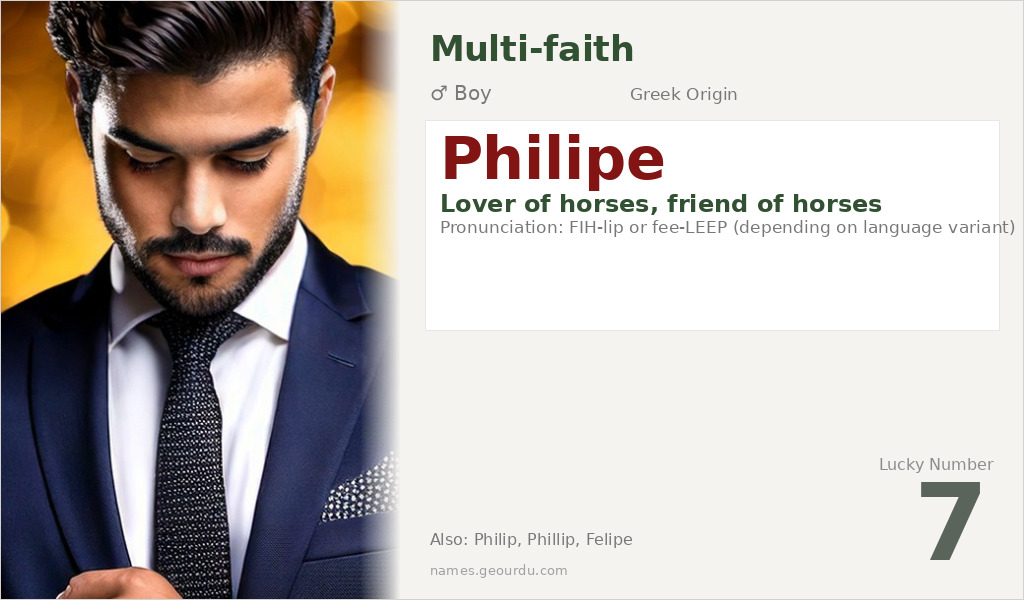
| 📛 Name | Philipe |
| 💎 Meaning | Lover of horses, friend of horses |
| 👤 Gender | Boy |
| 🕌 Religion | Multi-faith |
| 🌍 Origin | Greek |
| 🗣 Pronunciation | FIH-lip or fee-LEEP (depending on language variant) |
| ✍️ Urdu | فلپ |
| ✍️ Arabic | فيليب |
| 🔢 Numerology | 7 |
| ✨ Spellings | Philip, Phillip, Felipe, Philipp, Philippe, Filip |
Origin & Cultural Significance
Philipe originates from ancient Greece, where it was first documented as Philippos. The name gained prominence through Philip II of Macedon (382-336 BCE), whose military and political achievements established Macedon as a dominant power. From Greece, the name spread throughout Europe via Latin during the Roman Empire and later through Christianization. It became particularly popular among European royalty, including kings of France, Spain, and Portugal. Today, variants of the name are used across multiple cultures and religions, including Christianity, Islam (as Filip in some Muslim communities), and secular contexts worldwide.
Personality Traits
Those named Philipe often exhibit qualities associated with leadership, loyalty, and adventure. The name’s equestrian roots suggest characteristics of strength, grace, and endurance. Historically, bearers of this name have been known for their strategic thinking and ability to inspire others. Modern Philips/Philipe’s are frequently described as charismatic individuals with natural communication skills and a love for exploration and new experiences.
Similar Names
If you like Philipe, consider: Philip, Phillip, Felipe, Philipp, Philippe, Filip, Philo, Hippolytus, Xanthippe, Theodore
Famous People Named Philipe
- Philip II of Macedon — King of Macedon and father of Alexander the Great
- Prince Philip, Duke of Edinburgh — Husband of Queen Elizabeth II of the United Kingdom
- Felipe VI — Current King of Spain
- Philipp Lahm — German former professional footballer
Frequently Asked Questions About Philipe
What does Philipe mean?
Philipe means 'lover of horses' or 'friend of horses,' originating from the Greek words philos (friend/lover) and hippos (horse).
Is Philipe a boy or girl name?
Philipe is traditionally a masculine name, though feminine variants like Philippa exist. Across all cultures where it's used, it remains primarily a boy's name.
What is the origin of Philipe?
Philipe originates from ancient Greek, specifically from the name Philippos. It spread throughout Europe via Latin and has been used across multiple cultures and religions for centuries.