
Table of Contents
Panchavaktra is a profound Sanskrit name steeped in Hindu mythology and devotion. Meaning ‘five-faced’ or ‘having five aspects,’ this name directly references Lord Hanuman’s powerful Panchamukhi (five-faced) manifestation. While not commonly used as a personal name in modern times, it holds significant religious importance as an epithet describing one of Hanuman’s most revered forms. Understanding this name offers insight into Hindu iconography and the rich symbolism of divine manifestations.
Meaning of Panchavaktra
Panchavaktra is a classical Sanskrit compound name with precise linguistic roots. The first component ‘pancha’ (पञ्च) is a cardinal number meaning ‘five,’ appearing in numerous Sanskrit words like Panchatantra (five principles) and Panchanga (five limbs of time). The second component ‘vaktra’ (वक्त्र) means ‘face, mouth, countenance, or opening,’ derived from the root ‘vac’ meaning ‘to speak.’ Together, they form ‘Panchavaktra’ – literally ‘five-faced.’ In Hindu theological context, this specifically describes Hanuman’s Panchamukhi form where each face represents different deities: Hanuman (east, courage), Narasimha (south, protection), Garuda (west, victory), Varaha (north, strength), and Hayagriva (upward, wisdom). This name appears in various Hindu texts describing Hanuman’s manifestation to simultaneously extinguish five lamps while rescuing Rama and Lakshmana from Ahiravana’s underworld.
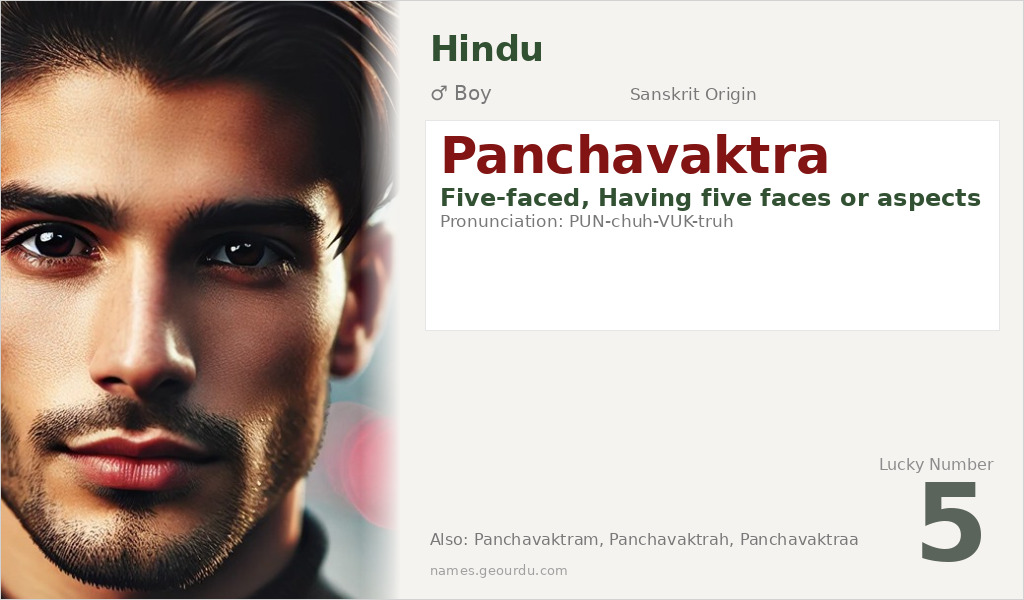
| 📛 Name | Panchavaktra |
| 💎 Meaning | Five-faced, Having five faces or aspects |
| 👤 Gender | Boy |
| 🕌 Religion | Hindu |
| 🌍 Origin | Sanskrit |
| 🗣 Pronunciation | PUN-chuh-VUK-truh |
| ✍️ Urdu | پنچ وکٹرا |
| ✍️ Arabic | بانشافاكترا |
| 🔢 Numerology | 5 |
| ✨ Spellings | Panchavaktram, Panchavaktrah, Panchavaktraa |
Origin & Cultural Significance
Panchavaktra originates entirely from Sanskrit language and Hindu religious tradition, with no verifiable connections to other language families like Arabic, Persian, or regional Indian languages. The name emerges from the Hanuman Chalisa and other devotional texts that describe Hanuman’s five-faced form. Culturally, it represents an important aspect of Hanuman worship, particularly in South Indian traditions where Panchamukhi Hanuman temples are established. Historically, the concept reflects the syncretic nature of Hindu iconography, where one deity incorporates aspects of others. While the name is documented in religious contexts, it is rarely used as a personal given name in contemporary Hindu communities, functioning more as a descriptive religious epithet than a conventional baby name.
Personality Traits
While personality associations with names are largely cultural rather than empirical, names like Panchavaktra carry symbolic weight. The five-faced aspect suggests someone with multidimensional capabilities, able to address different challenges with appropriate approaches. Such individuals might display the protective fierceness of Narasimha, the loyal devotion of Hanuman, the soaring vision of Garuda, the grounded strength of Varaha, and the intellectual wisdom of Hayagriva. In Hindu naming tradition, such names often inspire the bearer to embody the virtues of the divine form they reference.
Similar Names
If you like Panchavaktra, consider: Panchamukhi, Panchanana, Chaturmukha, Trimurti, Hanuman
Famous People Named Panchavaktra
- No widely known contemporary figures bear this name as it is primarily a descriptive epithet of Lord Hanuman rather than a common personal name. In Hindu tradition, it refers specifically to the five-faced form of Hanuman worshipped in certain temples.
Frequently Asked Questions About Panchavaktra
What does Panchavaktra mean?
Panchavaktra means 'five-faced' or 'having five faces' in Sanskrit. It specifically refers to Lord Hanuman's five-faced form (Panchamukhi Hanuman) in Hindu mythology.
Is Panchavaktra a boy or girl name?
Panchavaktra is exclusively a boy name in Hindu tradition, as it refers to a masculine deity (Lord Hanuman) and his manifestations.
What is the origin of Panchavaktra?
Panchavaktra originates from Sanskrit language and Hindu religious tradition. It is a compound of 'pancha' (five) and 'vaktra' (face), specifically describing Hanuman's five-faced form documented in Hindu scriptures.





